
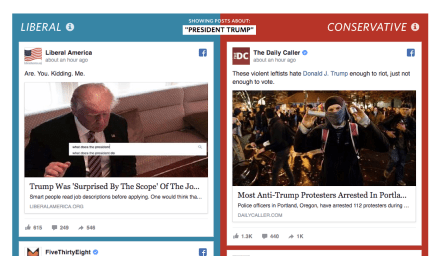
 An interesting piece from the Wall Street Journal in which you can compare the kinds of articles you see if your friends are mostly sharing news from conservative or liberal sites. Consider what the effect is of being bombarded by one set of stories rather than the other. How would that paint your perspective of events and issues? Furthermore, what does that do for your ability to understand what other people are thinking? To some degree we choose these bubbles we live in and to some degree that are imposed on us by the technology we interact with.
Though I read a variety of news sources (including many of the “alt-right” news sources promoting Donald Turmp’s message), of the few hundred “friends” I have on facebook more than a hundred “like” Hillary Clinton on facebook and only two “like” Donald Trump. These are people who I went to high school, college, and grad school with. People I worked with and former students. Despite the variety of sources of people, overwhelmingly, I see people sharing and discussing similar opinions and world views. To some degree this is the result of geography (growing up, living and working in New York), and profession (teachers tend to be Democrats).
When people interact with information on social media, generally speaking, they are bombarded with messages from people who have similar views and this results in a very distorted sense of what people in general think or what people “on the other side” think. People are more certain of the “truth” of their beliefs and more certain of the absurdity of others. I know that none of this is in any way new information but it is still important to reflect on.
http://graphics.wsj.com/blue-feed-red-feed/#/trump
Here is an article from the New York Times, that discusses the issue of “fake news” along with the idea of the “echo chamber” in which we only hear opinions we agree with.
Here is a TED talk from 2011 about this very topic. More relevant now than ever.

 Clinton School Participation in Government